D(-)prolinol
D-Prolinol
CAS 68832-13-3 · C5H11NO · MW 101.15 g/mol
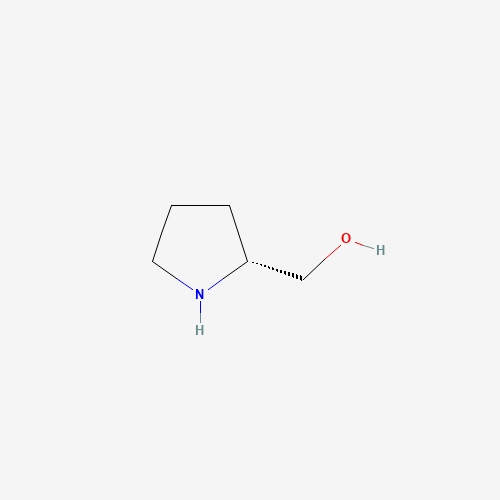
O związku D(-)prolinol
D(-)prolinol (D-Prolinol) to związek chemiczny zarejestrowany pod numerem CAS 68832-13-3 o wzorze sumarycznym C5H11NO i masie molowej 101.15 g/mol.
Cząsteczka zawiera 18 atomów połączonych 18 wiązaniami chemicznymi. Pełna nazwa systematyczna IUPAC dla tego związku to [(2R)-pyrrolidin-2-yl]methanol. Powyższy interaktywny model 3D pozwala obejrzeć układ przestrzenny atomów — można go obracać przeciągnięciem myszką, powiększać scrollem oraz przełączać między trybami wizualizacji szkieletowy / Ball & Stick / Space Fill.
Pod względem właściwości fizykochemicznych współczynnik podziału logP = -0.3 (wartość ujemna, związek hydrofilowy), powierzchnia polarna PSA = 32.3 Ų, 2 donorów i 2 akceptorów wiązań wodorowych. Te parametry są kluczowe przy ocenie biologicznej dostępności i interakcji z biomolekułami.
Dane chemiczne dla tego związku pochodzą z PubChem (NIH NLM NCBI), jednej z największych baz związków chemicznych na świecie. Wszystkie informacje są aktualizowane automatycznie i wzbogacone o polskie tłumaczenia zwrotów GHS zgodne z Rozporządzeniem CLP (1272/2008/WE). Powyższy widget można używać do celów edukacyjnych, badawczych i komercyjnych.
Właściwości fizykochemiczne
| Wzór sumaryczny | C5H11NO |
| Masa molowa | 101.15 g/mol |
| IUPAC | [(2R)-pyrrolidin-2-yl]methanol |
| SMILES | C1C[C@@H](NC1)CO |
| InChIKey | HVVNJUAVDAZWCB-RXMQYKEDSA-N |
| logP (XLogP3) | -0.3 |
| PSA | 32.3 Ų |
| HBD / HBA | 2 / 2 |
| PubChem CID | CID 2724541 ↗ |
Bezpieczeństwo GHS
Sygnał: Uwaga
H315 — Działa drażniąco na skórę
H319 — Działa drażniąco na oczy
H335 — Może powodować podrażnienie dróg oddechowych
Literatura naukowa
Literatura naukowa
20 artykułów · 13 open access · Źródła: PubMed, OpenAlex, Semantic Scholar
📈 Timeline publikacji (20 artykułów)
Wysokość słupka = liczba artykułów w roku. Hover dla szczegółów.
The study provided the insights into Dietzia in respects of oil degradation and biosurfactant production, and will help to evaluate the potential of DietzIA in marine oil removal.
It is discovered that this genome displays high efficacy and conciseness as a nutrition enhancer, encompassing a cumulative sum of 2921 genes encoding proteins and a GC content of 45%.
The non-pathogenicity and the food-processing ability of this strain have rendered this strain industrially important and provides a starting point to investigate the strain’s healthcare-related applications as well.
Variation in the KAP13-3 gene may affect gene expression, the structure and assem- bly of the protein, and consequently influence wool traits, if KAP 13-3 is of importance to wool fibre structure.
In the main effects models, maternal PFC concentrations were not significantly associated with daughters’ %BF; however, there were some differences in the associations between maternal PFC concentrations and daughters’ %BF by mothers’ educational status.
Assessment of the capability of probiotic L. plantarum 13-3 to convert Linoleic Acid (LA) to different fatty acid metabolites in the medium supplemented with differential concentrations of LA confirmed that several enzymes including the linoleate isomerase, acetoacetate decarboxylase and oxidoreductase may be involved in biotransformation of LA into fatty acids metabolites.
The SCCS has concluded that propylparaben is safe when used as a preservative in cosmetic products up to a maximum concentration of 0.14 % and the current level of evidence is not sufficient to regard it as an endocrine disrupting substance.
The authors claim that the Dietzia maris As-13-3 strain could play significant role in oil degradation, biosurfactant production, and marine oil removal and revealed a complete pathway for the biodegradation of alkanes by terminal oxidation.
Dane z PubMed (NIH NLM), OpenAlex (CC0), Semantic Scholar (AI2). AI Summary wygenerowane przez Semantic Scholar TLDR. Artykuły z ikoną  wymagają płatnego dostępu.
Synonimy
Źródła danych
- 📊 PubChem CID 2724541 — NIH
- 🔬 NIST WebBook — spektroskopia
- 🌐 Wikidata
- 💊 ChEMBL — bioaktywność